

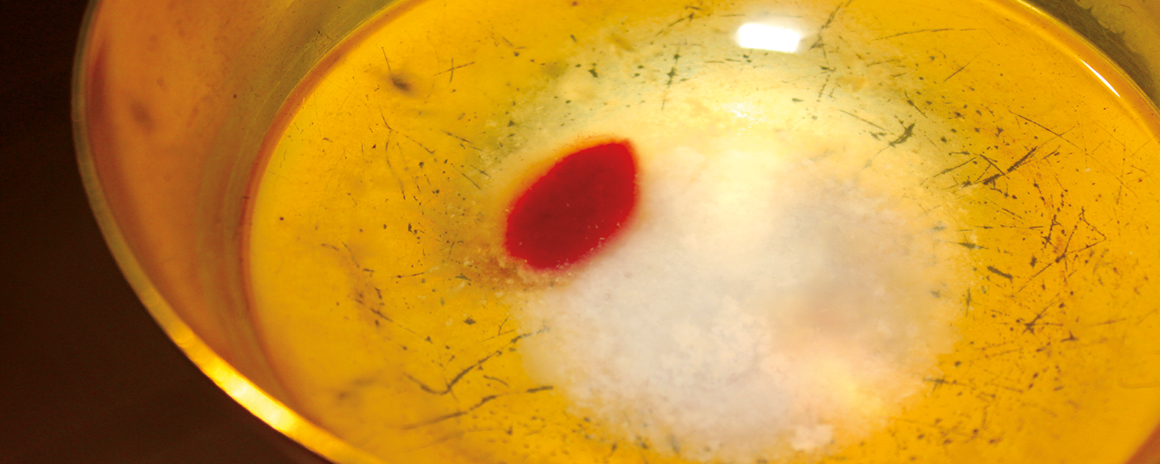
Barbara Engel, a cardiologist, was part of the special commission for the examination of the Eucharistic miracle that took place in Legnica (Poland) in 2013.
It all began on Christmas Day 2013 when, during the morning Mass in St. Hyacinth’s Shrine, Legnica, a priest distributing Holy Communion dropped a consecrated Host, which had just been dipped in the Precious Blood, to the floor. Acting according to the prescribed procedures, the priest picked it up and put it in a special vessel (vasculum) and then filled it with tap water. Next, he placed the vessel in the tabernacle. In early January 2014, another priest serving in the parish wanted to see how the process of Host dissolution was proceeding. To his great surprise, he noticed the Host was still intact and in addition it had a red stain, covering approximately one-fourth of the Host. It was observed for several days. Since the coloring persisted, Bishop Stefan Cichy, the then local ordinary, was informed of the matter. He resolved to keep the Host in water for four weeks, because it usually takes that much time to dissolve, and examine it again. After this period, the stained fragment of the Host slightly changed color: from vivid red, it turned brown-red or the color similar to that of a tissue. In turn, the white part dissolved and fell to the vessel bottom. What is more, the stained fragment’s structure altered, too. It was no longer an ordinary stain. A thickening appeared on it, thicker than the Host itself. It was at this point that Bishop Cichy appointed a commission to look into the phenomenon. I was one of its members. The phenomenon I saw moved me so much that I started experiencing sleep problems. It was the first time in my life that I had witnessed something like that.
It fell to me to develop the program of examinations. First, I made the decision to approach the Department of Forensic Medicine of the nearest medical university. I believed it to be the right choice as it was able to identify various materials of unknown origin. On January 26, 2014, a team from this Department arrived at St. Hyacinth’s Shrine. The team included the Department Head, who performed a professional forensic-medical inspection and collected 15 samples for multi-profile examinations: histopathological, genetic and microbiological. The samples had to be taken not only from the material to be examined, but also from its environment, that is, the water in which the Host had been submerged. In addition, swabs were taken from the surroundings of the chalice and from the place it stood in. Other consecrated Hosts, the wine and the tap water were examined as well. This was a very professional inspection. All one could do then was to wait for the results. They arrived in March 2014.
The histopathological examination showed the collected sample to be made up of heart-muscle tissue, largely degraded – most certainly due to the long submersion in water. The degradation resulted from physiological self-destruction processes. Owing to the fact that some examiners knew the origin of the examined material, they found it difficult to acknowledge the results. They knew that the examined material had not been substituted or fabricated, because they had collected the samples themselves. How was it possible then that in the middle of the examined Host a fragment of a heart-muscle tissue was found? A failure to answer this question was excused by the fact that the image of the examined material was not entirely clear, due to its partial destruction. For this reason, many histochemical and immunohistochemical tests were carried out. Furthermore, microbiological tests and ones designed to detect the presence of fungi ruled out the possibility that the growth was some bacterial or fungal colony. The genetic tests did not identify any DNA, which raised doubts as to whether the tissue did indeed correspond to a heart-muscle tissue. What appeared highly unusual was the fact that no DNA traces were found, which should have been left by persons examining the sample. To tell the truth, all those who examined the sample saw a heart-muscle tissue. However, they lacked the courage to say: “Yes, this is a real heart-muscle tissue.” The official results were ambiguous, vague and differed greatly from the unambiguous conclusions and opinions that had been formulated in private conversations.
A Real Human Heart
I knew I was on an important mission and I was determined to accomplish it. It made me angry when I heard examiners say in a private conversation: “Yes, this is it” and then refuse to go on the record as saying the same. On reflection, however, I wondered if I myself was able to bear testimony to God. In my work environment, where I meet all kinds of people, the subjects of God and faith are sometimes talked about. As a doctor, do I employ my authority to bear witness to Christ or do I rather evade an unambiguous siding with him out of fear of being ostracized, excluded, shunned or criticized?
The dislike for or even outrage of some scientists I knew at my mission made me even more motivated to complete my task. There were many more such adversities in my way, but as I encountered them I realized the greatness of my mission. Together with other commission members, I visited various departments of forensic medicine. No person we met there remained indifferent to the story, albeit reactions to it differed widely.
Finally, I arrived at the Department of Forensic Medicine, Szczecin Medical University, which has a lot of experience in identifying and examining the DNA of any specimen whose biological state is difficult to analyze. There are, for instance, the bodies of Polish national heroes who were murdered during the Nazi and Communist terrors. One of the professors of this University agreed to carry out the examinations. I thought it would be yet another of many conversations, meanwhile the professor was clearly moved by the task facing him. When he looked at the pictures of the specimen, he said: “This is a heart-muscle tissue.” Next, he placed the specimens in ultraviolet light and filtered them through an orange filter and said afterwards that there was no doubt! The image highlighted all the tissue elements. I was doubtful, however, if the professor would have enough courage to put this down in writing. He called me and said that two amplifications of the DNA material had been done and that the tissue undoubtedly was human! The professor did put down the results in writing. For me, personally, it was a breakthrough. I realized that we had been dealing with an incident that certainly was a miracle, because nobody was able to explain how muscle tissue was found in a Communion Host. The doctors who examined the samples could not tell where it came from. A test repeated twice confirmed that it contained human DNA and that it was fragmented. This, in turn, corresponded to the histopathological image, showing a damaged tissue as a result of its long submersion in water.
Lanciano
In the meantime, encouraged by the scientific approach by the Szczecin professor, I decided to visit Lanciano (Northern Italy), where another Eucharistic miracle took place in the 8th century. I hoped that I would find scientists there who would help me in my endeavors. I thought that all that was necessary was to compare the DNA of a Legnica sample with the DNA of the miraculous Lanciano Host. While there, I got hold of a 1991 report written by some UN doctors. It gave the results of hundreds of detailed tests to which the Lanciano Host had been subjected. The report bore out the results of earlier examinations and described a number of more recent tests. All of them found the Lanciano Host to be the muscle tissue of a heart that is alive but in agony. However, the report did not draw any further conclusions and essentially brought nothing new.
When I saw the sweeping nature of the examinations and the total helplessness of the scientists, who faced a mystery surpassing their human understanding, I shivered. I saw how great God was and what a speck of dust our supposedly “great” scientists were. The report exposed the complete helplessness of a team of scientists who, at the same time, had not been limited in any way in their research. Having at their disposal everything that the science of the day could muster, the scientists were only able to arrive at the same conclusion as the one reached 10 years earlier by a single doctor…. The report ended with a poignant question: “Who are you?” I then told my daughter that we had seen enough evidence in this document and that we were going to confession. The reading of the report was a turning point for me. I realized then a simple thing: God shows as much as he wants to and no more. I understood what it meant – that he loves us. He loves us with a love to the love we ask for: free and selfless. After all, it is impossible to pressure someone into loving anybody.
Science, Faith and Humility
Through extraordinary interventions and Eucharistic miracles, God wishes to move us. However, he never puts us in a situation where we would have no choice but to side with him, which would mean we would not be able to exercise our free will. God may give us signs that will leave us in no doubt that he exists. However, the Creator does not wish to restrict anybody’s freedom. I told myself: “For as long as you live you will travel the world and talk to all kinds of people; there will always be somebody saying ‘but’, because there will always be somebody who will question your conclusions.” I understood then that it was high time I (had) stopped doing any further examinations, because there was already enough evidence. The rest depends on whether God grants faith to a person. With this conviction, I set out on my way home. God, however, changed my itinerary in an extraordinary way.
Due to a mistake I made concerning an appointment in Lanciano, the date of my return to Poland had to be changed. I had to stay in Rome for another day. At the morning Mass in St. Peter’s Basilica, I met “by chance” Archbishop Krajewski, who a year earlier, at Corpus Christi, visited Legnica, where we had informed him about the miracle. Talking to him gave me a lot of strength. I resolved not to yield, but rather to continue my mission. It is incredible that I met the archbishop at that very moment. All he told me then later came true. I returned to Legnica. Once at home, I was asked by Bishop Zbigniew Kiernikowski to produce a dossier of the case, because he was about to travel to Rome. My daughter translated all the documents into Italian overnight and I was able to hand them to the bishop, who took them to the Congregation for the Doctrine of the Faith. I expected that we would have to be patient and wait. Unexpectedly, an answer from the Vatican came after roughly a month! It was on March 10, 2016, on Good Thursday… If one considers all the procedures and time traditionally needed to decide such cases, the answer was very quickly indeed! God can do anything. If he wanted this Eucharistic miracle to come to light, he used even so weak a tool as me. I carried my mission through to the end only because God so willed and I only had to accept his will.
It seems as if God was saying to us: “You will know as much as I want you to know.” We would like God to give us great, unambiguous and spectacular signs. We do not understand, however, that he is very tender in his love and never wishes to put us in a situation of coercion. By analogy: I – as a wife – would not like my husband to love me only because he is afraid of me or he has no other choice. Nobody can be coerced to love. Jesus told Alicja Lenczewska: “I hide myself so that you are not captivated by the magnificence of my gift.” (Word of instruction, 430) These words have a great appeal to me. I wish I had discovered them earlier. It will never happen that we will receive evidence that would “leave everybody overwhelmed.” God does not force anybody to do anything. If a man seeks the truth, the search will bring him to the decision of faith. For example: everything indicates that the Shroud of Turin dates back to the times of Christ. I, however, must believe that it was Jesus who was wrapped in it. This must be an act of faith.
Over the two years of examining the Eucharistic occurrence in Legnica, I had been growing in faith. I had always declared myself to be a believer, but my faith was rather superficial. Inside, I was in principle like others, who refused to accept the truth that in the Eucharist is found the presence of the living and true Jesus Christ. I used to be very impatient. Now, I am still sometimes impatient, but I know what it means to agree to God’s will. In my work, I try to approach everything with much greater humility. If I ask God for something, I say: “Lord, I ask you for this if this agrees with your plans. If, after all, I do not receive what I want, then give me the strength to accept this – knowing that it is what you want to give me. If I have a problem with accepting this, then I am sorry. Give me time and I will accept this. Give me strength and I will go wherever you want me to go.” Life is really very beautiful and now I have a taste for it.
Barbara Engel M.D.