

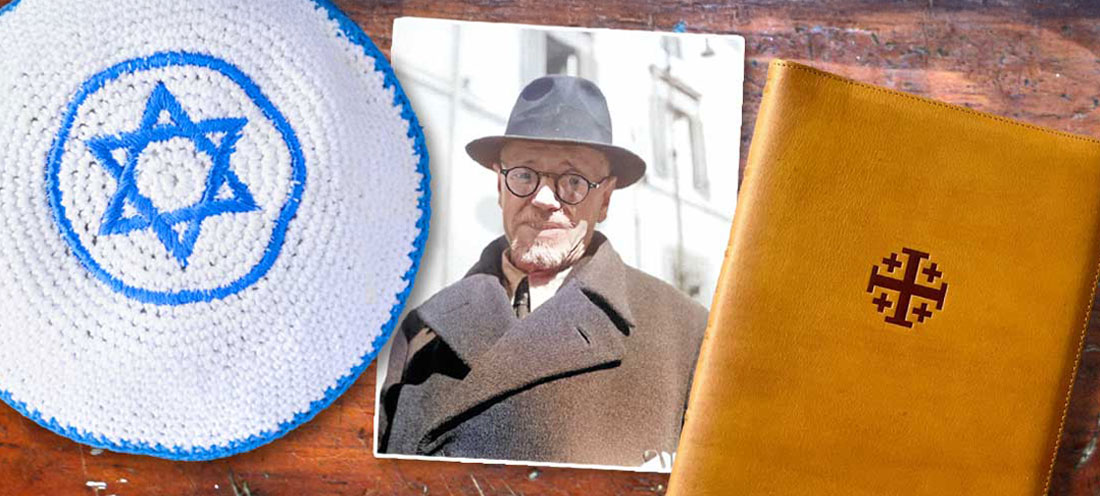
On February 13, 1945, the world’s leading news agencies broke the news that the Chief Rabbi of Rome, Dr. Israel Zolli, had been received into the Catholic Church. He was born in 1881, in Brody, in the region of Poland then under Austrian rule (Galicia). His mother came from a family of learned rabbis. His father belonged to the wealthy Zollers, owners of a silk factory in Łódź.
Childhood
As a small boy, Zolli, like many other Jewish children in Poland, had Catholic friends. “We Hebrew children loved our Christian friends,” he would later write, “and they loved us. We knew nothing about racial differences. We knew our religions differed. That is why when it came to religion class we went to different rooms. But once the lesson was over we were together again.”
Israel often visited the hospitable home of his friend Stas. While visiting there, he would stare in wonder at the large crucifix on the wall. It was then that he first began asking questions. Who was ths man on the cross? Why had he been crucified? In his religion class in the Jewish community, he was told Jesus was a blasphemer, since, being a man, he considered himself God. That is why he had been condemned to death on the cross. But Israel saw that Stas, his mother, and many other adherents of the crucified Jesus were people of great kindness and unselfish love. Since they had such love in their hearts, how great then must have been the love of Jesus in whom they believed! The testimony of their lives drew young Israel’s thoughts closer to the crucified Jesus. These thoughts about the suffering and death of Jesus took on fresh vigor when in Hebrew school he learned about Jahweh’s Suffering Servant in the Book of Isaiah. Although his teacher in the Jewish community taught that the Servant of Jahweh represented the Chosen People as a whole, or at least one of the kings of Israel, yet Israel’s thoughts about Jesus never left him. Intuitively he felt that the suffering Servant in the Song of Isaiah was the crucified Jesus.
Israel’s mother had a great influence on his religious upbringing. She was a prayerful woman, filled with an unselfish devotion to helping others. “O my dear mother,” he would write to her years later, “now I understand and delight in you and your soul; (…) You, mother, are also like that suffering servant in the Bible.” The patient and lovingly borne sufferings of his mother would in turn direct the thoughts of the growing Israel to the silent suffering Servant of Yahweh in the Book of Isaiah. The boy began to discover in his heart the mystery of God’s solidarity with suffering humanity, and the sign of this solidarity was Jesus on the cross.
Studies
In 1895 the Zoller family moved east and settled in the Lvov area. Young Israel studied diligently so as to qualify as a teacher of religion in the Jewish community. But the more theological knowledge he gained, the more he returned to the question: could Jesus on the cross be the Messiah and the true God? This prompted him to a close reading and analysis of the Gospel texts. He compared the texts of the Hebrew Bible with those of the New Testament. He read the rabbinical commentaries and compared them with what he found in the teachings of Jesus. To his great amazement, he discovered that rabbinical exegesis pointed to the self-divinization of the patriarch Jacob who unconsciously placed himself in the role of the Messiah to come. Thus, from the point of view of the Jewish rabbis, the notion of Jesus’ divinity was not entirely unacceptable.
Following the death of his dear mother, Israel began his studies at the University of Vienna. Later he moved to Florence where he studied at the Rabbinical College there and also the Institute of Higher Studies. He graduated with a doctorate in psychology and diplomas in Judaic studies, linguistics, and philosophy. In 1913 Israel Zoller married Adela by whom he had a daughter Dora. Alas, after four happy years of marriage, Adela took sick and died. For Israel this was a particularly painful experience.
Chief Rabbi of Trieste
In 1920, Israel married again and was appointed chief rabbi of Trieste. Soon after, his new wife Emma gave birth to a daughter, Miriam. To qualify for Italian citizenship in 1933, he was obliged by the fascist authorities to change his surname to the more Italian sounding Zolli. He also assumed the chair of the Department of Hebrew Language and Literature at the University of Padua. Among his students were numerous Catholic priests and seminarians who felt drawn to Professor Zolli’s spirituality. They prayed that he be received one day into the Catholic Church.
The rabbi’s work and family responsibilities absorbed him intensely. In his spare time he devoted himself to the reading of the Old and New Testaments. It was becoming increasingly clear to him that all the prophecies and promises of the Old Testament had been fulfilled in the New. Thoughts of being received into the Catholic Church occurred to him even then.
As he delved deeper into the Gospels, Rabbi Israel became more and more fascinated by the person of Christ. He recalls that once while writing a scholarly article, he suddenly stopped and found himself invoking the name of Jesus. After a while he “saw Him, as if in a large picture without a frame, in the dark corner of the room. I gazed on Him for a long time without feeling any excitement. . . I had no desire to speak of it to anyone, neither did I think of it as a conversion. What had happened concerned me, and only me. My intense love for Jesus and the experiences I had concerned no one else; nor did they seem to me at the time to involve a change of religion. Jesus had entered into my interior life as a guest, invoked and welcomed. . . I felt myself to be a Hebrew, and I loved Jesus Christ. Neither Hebraism nor Christianity seemed to interfere in my love for Jesus. Jesus was present in me, and I in Jesus.” For Rabbi Israel Zolli this mystical experience of the Risen Lord’s real presence influenced the entire course of his life. He did not yet understand that to accept the person of Jesus meant to become a member of His Mystical Body, which is to say the Catholic Church.
Later, after being received into the Church, Zolli would observe: “Conversion consists in responding to a call from God. A man is not converted at a moment of his choosing, but in the hour when he receives God’s call. When the call is heard, the one who receives it has only one thing to do: obey.”
While engaged in his scholarly work, Rabbi Israel Zolli, an expert in Semitic languages, made a discovery of capital importance. He determined that the Greek text of the Gospels points to the existence of earlier Hebrew sources from which these Greek texts derived. Many years later, Catholic Biblicists such as Jean Carmignac and Claude Tresmontant would corroborate this discovery. It was of supreme importance, since it pointed to the reliability of the Gospel accounts. These accounts related the events exactly as they had taken place in the context of the culture and beliefs of Israel of the time.
In 1938, Zolli published his book Il Nazareno (The Nazarene) in which he clearly demonstrates that Jesus was the Messiah promised by God. The striking fact is that the Jewish community did not react at all to what Zolli said in his book about Jesus.
Chief Rabbi of Rome
In 1939, Zolli was appointed to the prestigious position of Chief Rabbi of Rome and Director of the Rabbinical College. For the Jewish community the time of the brutal persecution was drawing near. The Jews in Rome were then sharply divided. Most were convinced that the Germans presented no danger to them. They were confident that their friends in the ruling circles would guarantee their safety.
Throughout the dramatic years of the war, Rabbi Zolli played a central role in saving the Roman Jewish community from total elimination. The community was divided into antifascists and those who collaborated with the authorities. A few hours prior to Rome’s occupation by the German army, Rabbi Zolli received reliable information that the Germans were planning the total extermination of the Jewish population. He consequently appealed to Almanasi, president of the Union of Jewish Communities, to order the evacuation of Jews living in Rome. Almanasi made light of his warnings, while accusing Zolli of exaggeration and sowing fear and confusion. But the Chief Rabbi of Rome did not stop spreading word of the approaching danger. He called for the destruction of all registers of Jewish names and addresses and the closing of the synagogues and community offices. He also urged his fellow Jews to seek shelter in monasteries and rectories. But his appeals fell on deaf ears. The president of the Jewish community in Rome, Ugo Foa, went so far as to ridicule Rabbi Zolli. He advised him to go to the pharmacy and buy himself a remedy for lack of courage.
From the very first day of Rome’s occupation by the German army (September 8, 1943), the Jewish community found itself in a dire situation. On September 27, the SS commander of the garrison, Lieutenant-Colonel Herbert Kappler, demanded that the community hand over 50 kilograms of gold within 24 hours. If they failed to deliver, he would begin the deportation of all men of Jewish origin. The community managed to collect 35 kilograms. Another 15 had to be found. Only a few hours remained. In this dramatic situation Rabbi Zolli decided to turn to Pope Pius XII. To reach the Vatican, he had to evade the German police force. He went disguised as a building inspector. Upon reaching the office of the Secretary of State of the Apostolic See, he begged for the loan of 15 kilograms of gold, arguing that ‘the New Testament could not neglect the Old.’ Pope Pius XII immediately instructed his staff to hand the Chief Rabbi of Rome a package containing 15 kilograms of gold. Without delay, Zolli conveyed it to the president of the Jewish community along with a letter requesting that if the Germans should take any hostages, his name should stand first on the list.
But the Nazi occupiers could not be trusted. Though he received his 50 kilograms of gold on the night of October 15 and 16, 1943, Commandant Kappler ordered the arrest of eight thousand Jews, at which Pope Pius XII raised a sharp protest. That very day the Germans arrested about 1000 Jewish men, women, and children and transported them to the death camps; the rest of the community fled and went into hiding. Only then was the president of the community, Ugo Foa, persuaded of the mortal danger facing the Jews. He took such fright that, forgetting all about the arrested, he fled at once with his children to Livorno. Meanwhile, Rabbi Zolli prayed: “Lord, allow me to die with them, but only at a time and in a manner chosen by you, and not the Germans. Have mercy on your people.”
Fearing arrest, Zolli, his wife and daughter were forced to go into hiding in Rome. Several times they had to change their place of refuge. Zolli was then able to see the heroism of the priests, brothers, nuns, and Catholic families who, at great risk to their lives, accepted the Jews into their rectories, seminaries, cloisters, convents, and homes. The chief instigator of this rescue action was Pius XII himself who issued a special proclamation appealing for aid for the Jews. In his autobiography titled Before the Dawn, Zolli wrote: “There is now almost no place where the Pope’s spirit of love has not reached. One could write volumes on the various kinds of assistance Pius XII has provided.” Yet the rabbi sensed that there would be those in the future who would falsely and maliciously cast aspersions on the Pope. In 1945, he wrote to his wife: “You will see, one day they will blame Pope Pius XII for the world’s silence in the face of the Nazi crimes.”
After Rome’s liberation by the Allies, Zolli resumed his duties as chief rabbi. In July 1944, he presided over a solemn prayer service in the Roman Synagogue. The event was broadcast by radio, allowing him to publicly thank Pope Pius XII and the President of the United States for their role in assisting the Jews in Rome during the time of the Nazi persecutions.
On 25 July 1945, Zolli attended a private audience with Pius XII where he thanked the Pontiff for his extraordinary personal involvement in aiding the Jews. Through the Pope, he also conveyed his thanks to the Catholics of Rome—both lay and clerical—who had, at great risk to their lives and personal sacrifice, sheltered and assisted thousands of Jews.
The perverse attitude of Ugo Foa, the president of the Jewish community in Rome, caused Zolli a great deal of grief. Foa denied he had ever received 15 kilograms of gold from the Pope through the Chief Rabbi’s mediation. He also denied that Zolli had warned the Jewish community of the danger of extermination by the Nazis. Foa went even further. He accused Zolli of neglecting his rabbinical duties during the German occupation and of abandoning the Jewish flock entrusted to his charge. Shortly after the liberation, in July of 1944, Ugo Foa made bold to remove Zolli from his post as Chief Rabbi. But Rome’s American commissioner, Charles Poletti, repealed the decision, fired Ugo Foa, and dissolved the Roman Jewish Community Council, which had come into existence under the fascist authorities. And so Zolli continued to act as Chief Rabbi.
Baptism
But Jesus made it clear to him that his time of service at the synagogue was drawing to a close. In September of 1944, on the Feast of Reconciliation, Zolli presided over the solemn prayer service in the Synagogue for the last time. During the service Christ appeared to him in a vision. He was dressed in a white mantle and radiated an ineffable sense of peace. In his heart Zolli heard him say, “You are here for the last time.” That evening at home, his wife told him: “Today when you stood before the Ark of the Torah, I imagined I saw the white figure of Jesus placing his hand over your head as though He were blessing you.” Zolli recalls: “I was amazed, but still very calm. I pretended not to have understood. She repeated what she had said, word for word. At this very moment we heard our daughter Miriam calling me: ‘Papaaa!’ I went to her room. ‘What is the matter?’ I asked. She said, ‘You are talking about Jesus Christ. You know, Papa, tonight I have been dreaming that I saw a very tall white Jesus, but I don’t remember what came next.’ A few days later I resigned my position in the Jewish community.”
Zolli had understood this to be a clear sign that Jesus was asking him to delay no longer and seek reception into the Catholic Church. After resigning his office as Chief Rabbi of Rome, he prevailed on the Jesuit professor, Paolo Dezza, of the Gregorian University to prepare him for baptism—discreetly and without fanfare.
Zolli’s resignation came as a great shock to all. The president of the Jewish community accepted it with great sorrow and offered him the post of director of the Rabbinical College. Zolli declined, which surprised and saddened the president, since Professor Zolli was the most suitable candidate for the post. Wishing to avoid negative reactions, Zolli did not reveal his main reason for declining the offer. Thus, having freed himself from all extraneous responsibilities, he, along with his wife Emma and daughter Miriam, prepared to receive the sacrament of baptism.
A few weeks later, on February 13, 1945, the Chief Rabbi of Rome and his wife were baptized in a private chapel adjoining the sacristy of S. Maria degli Angeli Church in Rome. Only 15 of his most trusted friends attended the celebration. No journalists were invited. Israel Zolli took the name Eugenio; his wife—Maria. Their daughter Miriam followed suit a few months later.
After his baptism he considered himself a completed rather than converted Jew, for the Catholic Church was the fulfillment of the promise of Judaism. In his words, the Old Testament was God’s coded telegram to humankind, and the one cipher, the one code to reading its contents, was Jesus Christ, who was both true God and true Man. As an eyewitness to the Holocaust, Zolli insisted that it was precisely the annihilation of Christian principles by Fascist ideology that contributed to that catastrophe. After the war he would write: “I am convinced that when this war is over the only way of checking the forces of destruction and achieving the reconstruction of Europe will be by accepting the principles of the Catholic faith, that is, the idea of God and universal brotherhood embodied in Christ—not a brotherhood based on race and übermensch, for there is ‘neither Jew nor Greek. neither slave nor free, neither male nor female; for you are all one in Christ Jesus’ (Gal. 3:28).”
On the night after his baptism, a news reporter telephoned him from the United States asking him to confirm the rumors that he had been received into the Catholic Church. Zolli confirmed them. The following day, all the main wire services in America and Europe broke the news that the Chief Rabbi of Rome had become a Catholic.
When the news of his conversion to Catholicism became public, Zolli began receiving threatening and offensive phone calls. The Hebrew monthly appeared with its cover bordered in black. The Roman synagogue declared a period of mourning and fasting, as was the custom in the event of the death of a rabbi. Zolli’s name was struck from the list of chief rabbis of Rome, as though it had never existed. The Jewish press ran articles portraying the converted rabbi as an irresponsible man and a traitor to the Jewish people. Zolli responded by denying that he had abandoned Judaism, since the Catholic Church was the culmination of the Synagogue and the Old Testament stood fulfilled in the person of the Messiah—the Risen Christ. With all his heart Zolli forgave his detractors, insisting they acted not with evil intentions but out of human weakness and a lack of knowledge. Things became so tense that Eugenio was forced to move out of his apartment, which was located near the synagogue. His wife and daughter found refuge in a cloister, and Professor Zolli took up temporary residence at the Gregorian University.
It was at this time that Pius XII invited the Zollis for a private audience at the Vatican. Deeply moved, they expressed their joy and gratitude to the Holy Father. They also expressed their love and forgiveness of their fellow Jews, who could not understand their decision to become Catholics. “Now that I am baptized,” observed Emma, “I cannot hate anyone. I love everyone.”
During his stay at the Gregorian University, Zolli received numerous visits from friends and enemies. Influential American Jews dropped in to persuade him to return to the bosom of Judaism, offering him whatever sum of money he wished. With great serenity, he refused every offer. A number of prominent Protestants also came to his door. Recognizing him as a scholar with a deep knowledge of the Scriptures, they asked him to prepare a refutation of the doctrine of Papal Primacy on biblical grounds. Zolli’s response was a book entitled Petrus, in which he used Holy Scripture to prove the case for Peter’s primacy and the succession of Popes. “Since protesting is not testifying, I do not intend to trouble anyone by asking the question why did they waited 1500 years to protest? For fifteen centuries the Catholic Church was recognized as the true Church of God by the entire Christian world. No one in all honesty can dismiss those 1500 years out of hand and claim that the Catholic Church is not the Church of Christ. I can accept only that Church which was proclaimed to all creatures by my ancestors, the twelve apostles, who, like me, came out of the Synagogue.”
Before the Dawn
In large measure Zolli attributed his conversion to constant prayer and meditation on the texts of the Old and New Testaments. In the course of this prayer he made personal contact with the Divine Person of the crucified and risen Christ. “Every evening,” he would recount in his autobiographical reflections, “I opened the Bible at random, seeking for meditation a text from the Old or New Testament. I read everything I found, regardless of where I alighted on it. In this manner the Person of Jesus and His teaching became very dear to me; it never had the taste of forbidden fruit.”
His study of the Old and New Testaments along with his various life experiences led him to the discovery that the prophecy of Yahweh’s Suffering Servant contained in the four songs of the prophet Isaiah (42:1-7; 49:1-5; 50:4-9; 52:13; 53:12) was fulfilled in the suffering and crucified Jesus. In this, he was aided by his many years of expert scholarly exegesis and perfect knowledge of Hebrew and Biblical Greek. The culmination of this research was his conviction that Yahweh’s Suffering Servant could be none other than Jesus Christ, who died for our sins and rose from the dead for our justification. “In this way,” he wrote, “after many years of study, meditation, and living the Judaism of the Old Testament, I eventually found myself in the Christianity of the New Testament. I had to admit in all honesty that I had become a Christian, and that is why I began to prepare myself systematically for the reception of baptism.”
Zolli saw his transition from Judaism to Catholicism not as a break with the past but as a continuation on the road to salvation. When his former co-religionists began accusing him betraying Judaism, he replied sadly: “My conscience is clear. I have renounced nothing. Is not the God of Saint Paul also the God of Abraham, Isaac, and Jacob? Saint Paul converted. Did he forsake the God of Israel in doing so? Did he stop loving Him? It would be absurd to say yes.”
After receiving baptism, Professor Zolli became a fervent daily communicant, devoting considerable time to praying before the Blessed Sacrament in his parish church and the university chapel at the Gregorianum. He always kept a crucifix on this desk. As an expression of his Marian devotion, he had an icon of the Blessed Mother with a lighted blessed candle always before it. Eugenio Zolli joined the third order of Franciscans and frequently expressed his great joy over being a Catholic. “You cradle Catholics,” he would write, “do not realize what great treasures the faith and Christ’s grace represent. People such as I, who have received the grace of faith only after long years of seeking, can appreciate the greatness of this gift and experience the enormous joy of being a Christian.”
Eventually Zolli found living quarters on the outskirts of Rome and resumed family life with his wife and daughter. At Pius XII’s instigation he was appointed professor at the Pontifical Biblical Institute in Rome where he began to lecture on Hebrew language and literature. He was often invited as guest lecturer to universities throughout Europe and the United States. His apostolic zeal was naturally directed toward his former co-religionists, whom he sought to bring closer to the truth of Christ. He paid special attention to recent converts, offering them both moral and material support.
A scholar to the end of his days, Zolli increased his apostolic activity through the publication of numerous books and articles in Italy and abroad. Heart problems plagued his final years. His last lecture, on divine justice and mercy in the Scriptures, took place in Vallicelli, in January of 1956. A few weeks before his death, he announced that Jesus would take him from this world on the first Friday of the month. His prophecy came true. He died in hospital on the first Friday of the month, March 2, 1956 at 3 pm, the very hour of his Savior’s death. On receiving the viaticum on his deathbed, he said: “I trust the Lord will forgive my sins. I commit myself entirely to God’s mercy.”
Zolli concluded his autobiographical reflections thus: “In the soul of each one of us Christ lives—Christ who is the way to God, the life of God, the truth of God. He lives in us, and we deny Him. (…) [O]ne fails to live a good life when one fails to live Christ fully.”
Eugenio Zolli discovered the greatest treasure—the risen Jesus Christ who teaches, heals, forgives all sins, and gives eternal life—all within the Catholic Church. We shall never find happiness if we do not entrust our whole life to Jesus; if we do not undertake the labor of journeying through life with Him in accordance with the Commandments and the Gospel. Every Catholic needs to give daily thanks for the incredible gift that is the grace of our faith, and beg for its increase.
Our best guide along the path of faith is Mary—the Mother of Jesus and our Mother as well. Let us entrust ourselves to her every day, that she may lead us to Jesus. Whoever prays daily receives the love of God, i.e. all that is needed for happiness. Who stops praying, loses everything: faith and, consequently, eternal life. We need to discipline ourselves to develop the daily habit of praying the rosary and the chaplet of Divine Mercy at set times, to find time for reading Sacred Scripture, and if possible, to attend Holy Mass and spend time before the Blessed Sacrament.
Life’s greatest tragedy is remaining in mortal sin. We need therefore to pick ourselves up immediately from every sin through the sacrament of Divine Mercy and so remain in a state of sanctifying grace. The testimony of Eugene Zolli’s life underscores the relevance of the words of Scripture: “if you confess with your lips that Jesus is Lord and believe in your heart that God raised him from the dead, you will be saved. For man believes with his heart and so is justified, and he confesses with his lips and so is saved” (Rom 10: 9-10); “He who believes in him is not condemned; he who does not believe is condemned already, because he has not believed in the name of the only Son of God” (Jn 3:18).